Wednesday, 2 October 2019

France Journal Liberation, Catalogne: citoyens d’Europe, c’est le moment d’agir

Par Alfred Bosch, ministre de l’Action extérieure du gouvernement de Catalogne — 21 octobre 2019 à 16:21
Des membres du mouvement citoyen Assemblea lors de la fête nationale catalane, en 2018 à Barcelone. Photo Roser Vilallonga. AFP
La condamnation d'indépendantistes à de lourdes peines de prison crée une «crise européenne majeure», estime Alfred Bosch, un ministre du gouvernement de Catalogne.
Catalogne : citoyens d’Europe, c’est le moment d’agir


Tribune. Cent ans d’emprisonnement. C’est le verdict final rendu par la Cour suprême espagnole dans le procès des anciens membres du gouvernement catalan, de la présidente du Parlement catalan et de deux leaders de la société civile. Cent ans pour avoir participé d’une manière ou d’une autre à l’organisation d’un référendum, ce qui n’est d’ailleurs pas illégal en Espagne selon la Constitution espagnole et qui a été explicitement enlevé du code pénal espagnol en 2005. Cent ans pour avoir exercé leurs droits de façon civique, pacifique et démocratique. Cent ans pour avoir laissé les gens voter, pour avoir mené un débat au Parlement et pour avoir défendu ses idées. Ces personnes, cher lecteur, viennent d’être jugées et condamnées pour leurs opinions politiques, en plein XXIe siècle, au cœur de l’Union européenne. Pour l’Europe des pères fondateurs, née sur la base des libertés et des droits fondamentaux, le 14 octobre est un jour sombre. La démocratie a été bafouée.

Aujourd’hui, c’est moi qui écris ces lignes, car mon prédécesseur Raül Romeva est en prison. Elu, démocrate comme moi, il vit depuis deux ans derrière les barreaux et le sera encore dix ans pour avoir pacifiquement défendu ses idées et celles des citoyens lui ayant octroyé le mandat d’organiser un référendum. Ce procès le condamnant lui et le reste des onze innocents est une erreur historique. Une erreur qui n’améliore en rien la situation, qui ne fait que l’aggraver.

Solution démocratique

Le gouvernement de Catalogne et la société catalane ont toujours cherché une solution démocratique à la tension politique avec l’Espagne. Le constat à la fois pour les citoyens et les élus catalans de l’impossibilité d’adapter le modèle des communautés autonomes à la réalité politique catalane du XXIe siècle a nourri ces dernières années l’explosion du soutien au «droit à décider» et au mouvement indépendantiste. Près de 80% des Catalans soutiennent le «droit à décider» et près de 50% de l’électorat (contre 10%-15% il y a une décennie) soutient le mouvement indépendantiste, un mouvement civique, pacifiste et démocratique. L’essence du mouvement indépendantiste est profondément démocratique : il repose sur la volonté de décider du futur de la Catalogne, moyennant un référendum sur l’autodétermination (tel que reconnu dans le droit international), comme cela a été fait en toute normalité démocratique en Ecosse et au Québec, entre autres.

Le gouvernement espagnol a pourtant toujours refusé d’écouter cette majorité de Catalans et n’a pas sérieusement cherché à établir un dialogue avec ses représentants élus au suffrage universel. Au contraire, leur unique réponse a été la judiciarisation du conflit. Pourtant, ce ne sont pas les tribunaux qui résoudront une crise politique majeure car, heureusement en démocratie, ce n’est pas l’emprisonnement des opposants politiques qui met fin aux désaccords.

Le dialogue doit prévaloir. Y parvenir, c’est la vocation la plus intime du gouvernement dont je fais partie, issu à la suite d’élections rarissimes, avec des candidats-élus déjà en prison, certains en exil, une autonomie régionale suspendue. Nous avons remplacé nos collègues avec la conviction la plus profonde de l’urgence de parvenir à un dialogue avec les autorités espagnoles. Nous avons un mandat collectif qui nous l’impose et nous ne pourrions pas y renoncer.


En effet, près de 80% des Catalans demandent que cesse la judiciarisation du conflit politique et souhaitent la libération immédiate des prisonniers politiques. De nombreux acteurs internationaux ont également appelé à l’apaisement des tensions et au dialogue politique. En France, une centaine de parlementaires de la République ont signé des tribunes – d’abord, en mars, 41 sénateurs, et plus récemment, 52 députés – pour dénoncer un procès contre une «sorte de délit d’opinion» et appelaient à la reprise du dialogue comme seule issue possible à la crise politique.
Judiciarisation

Pour sa part, Pedro Sánchez, Premier ministre espagnol, n’a jamais véritablement tenté de sortir politiquement de cette impasse. Cela est devenu évident avec les peines réclamées dès le début du procès, en février, par le parquet et l’avocat de l’Etat, deux personnalités liées directement ou indirectement au gouvernement espagnol. Certains pensaient que Sánchez désamorcerait le conflit, nous en avions l’espoir, mais nous nous sommes malheureusement rendu compte qu’il n’avait ni la capacité ni la volonté de le faire.

Ce procès et cette condamnation contre la démocratie mettent encore plus à mal la possibilité de trouver une solution au sein du royaume d’Espagne. La judiciarisation de la question transfère inévitablement ce conflit vers l’Europe, la conscience de ses citoyens, ses institutions et ses tribunaux internationaux. Plus que jamais, il est urgent que la communauté internationale s’implique activement dans la résolution de ce conflit. Il ne s’agit plus d’une affaire interne à l’Espagne, c’est une crise européenne majeure.


Le gouvernement de Catalogne est convaincu qu’une solution existe, et qu’elle passe non pas par la force ni par les tribunaux, mais par la négociation et le vote. Nous appelons la communauté internationale à prendre position en faveur de la démocratie et la négociation. Des droits fondamentaux sont bafoués en Europe et les démocrates européens ne peuvent rester silencieux, en fermant les yeux à l’injustice.

Ces neuf personnes innocentes, élus, membres de la société civile, citoyens européens, n’ont rien à faire en prison. Voter n’est pas un crime et le criminaliser ne sera jamais la solution. Les citoyens de Catalogne doivent pouvoir décider de leur avenir sans craindre la répression. La démocratie doit prévaloir. Aujourd’hui de l’autre côté des Pyrénées, demain peut-être ailleurs. Pour le bien-être de nos générations futures : citoyens d’Europe, c’est le moment d’agir.Alfred Bosch ministre de l’Action extérieure du gouvernement de Catalogne

Testimonio de joven protestaste cada noche sobre sus padres Fascistas!!

Ronnie Cowan MP: The subversion of democracy against the elected members of Catalonia must be exposed and shamed

Written by: Ronnie Cowan MP House of Commons

Posted On: 22nd October 2019


The right-wing parties of Spain have embarked on a concerted campaign to undermine the right of the people of Catalonia to decide on their own self-determination, writes Ronnie Cowan MP.

During the Spanish civil war, the Irish poet Charles Donnelly famously said, “even the olives were bleeding”. We cannot run the risk of the Kingdom of Spain returning in any way shape or form to those dark days, writes Ronnie Cowan MP.
Credit: PA images


Even the olives were bleeding.


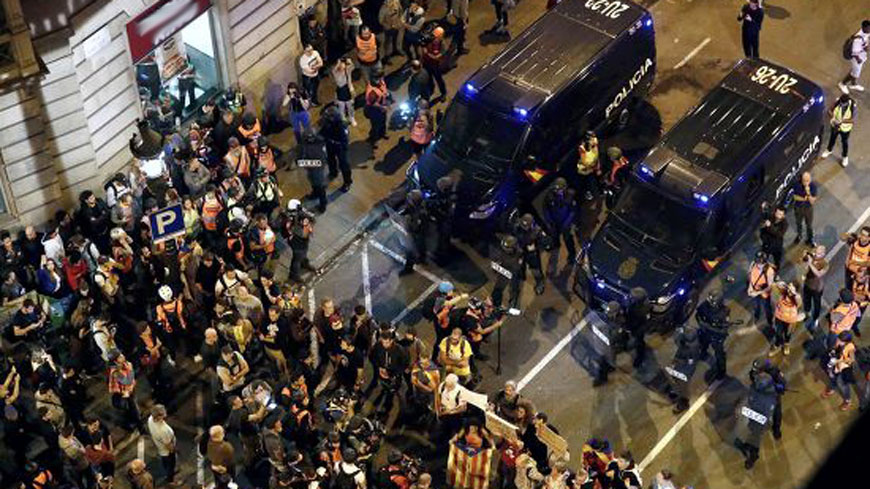
Over the last week or so I have watched, appalled, as the Mossos d’Esquaura have beaten, punched, and kicked peaceful demonstrators in Spain. There have even been cases of people losing an eye as the result of being shot by a rubber bullet. These bully boy tactics are not new. We saw them deployed on the day of the Catalonian referendum, the 1st of October 2017. Subsequently nine people have been sentenced to prison terms of between nine and thirteen years for their part in organising the referendum.

The people of Catalonia democratically elected three Members of the European Parliament, but they have been thwarted in their attempts to take up their seats. And five elected officials of the Spanish parliament, all former members of the Catalan government, have all been suspended. This subversion of democracy against the elected members of Catalonia must be exposed and shamed. The right-wing parties of Spain have embarked on a concerted campaign to undermine the right of the people of Catalonia to decide on their own self-determination. The overtones of Franco’s Spain are there for everyone to see. At this stage no one has been killed but while police vans drive at speed into protestors, citizens are clubbed to the ground and rubber bullets fired into crowds, is it only a matter of time before someone dies?

It is worth noting that for the five years before the referendum and the two years since, the people of Catalonia have held mass rallies and marches when hundreds of thousands of people have peacefully demonstrated without any arrests or violence or vandalism. I was in Barcelona in summer this year and watched rival protestors face off each other on a main road and it was all done through singing and chanting. I walked from one side of the argument to the other. Neither side was threatening, and both were happy to explain their views to me.

The ongoing state police violence has made that impossible now. And if we can’t have dialogue then we will never resolve this impasse. I was interviewed recently for a Spanish TV channel and they were clear to me. The vast majority of the people of Spain are outraged at what they are seeing. They fear for Spain’s image around the globe. This violence and subjugation of democracy is being perpetrated in their name and they abhor it.

The situation is now, as it has been for two years. The Catalonian government wants to sit down round the table with representatives of the government of the Kingdom of Spain and talk. It wants to find a diplomatic and democratic solution.

The Spanish government led by Pedro Sanchez refuses to engage. The leader of the official opposition in the UK parliament, Jeremy Corbyn was correctly critical of, the then, Prime Minister Mariano Rajoy when he oversaw the referendum and the police brutality that we witnessed that day. But he has been almost silent about the role now being played by his friend Prime Minister Sanchez.

All diplomatic channels must be opened and a peaceful solution must be found. Politicians do not serve themselves or the wider community well by remaining silent on this.

During the Spanish civil war, the Irish poet Charles Donnelly famously said, “even the olives were bleeding”. We cannot run the risk of the Kingdom of Spain returning in any way shape or form to those dark days.

Now is not a time to be bystanders, waiting to see where this will end. Without international pressure, it will not end well.

Council of Europe Platform and Human Rights report and concerns over Spain's treatment of Catalan civilians and journalists

Protection of the rights to freedom of expression and peaceful assembly during last week's demonstrations in Catalonia

STRASBOURG 21/10/2019
Protection of the rights to freedom of expression and peaceful assembly during last week's demonstrations in Catalonia
I am concerned at numerous reports of attacks against journalists covering demonstrations in Catalonia last week. The Council of Europe Platform for the safety of journalists has recorded 37 such instances. While some of these attacks have been carried out by demonstrators, several accredited journalists, wearing press visibility jackets, have reportedly experienced violent behaviour at the hands of police officers in different cities of Catalonia. Some journalists indicate that they were beaten up or had their equipment broken, others that they were hit by foam bullets shot by the police. I also take note of the arrest of a press photographer in the evening of Friday 18 October in Barcelona, while he was reportedly taking pictures of a police operation.
In general, I am worried about a context of growing insecurity for journalists reporting on the situation in Catalonia in recent months, with attacks against journalists on the rise.
In the current tense situation, ensuring full respect for freedom of expression, which includes the right to receive and impart information, is key. I therefore call on the Spanish authorities to investigate all reported cases of attacks against journalists, notably during last week’s demonstrations, whether they were carried out by police officers or demonstrators. Measures should also be taken to guarantee the safety of all journalists during demonstrations.
I am also concerned about allegations of disproportionate use of force and inappropriate use of anti-riot weapons by the police on demonstrators during last week’s protests. I fully acknowledge the numerous challenges faced by police officers who had to confront violent attacks and deal with numerous acts of vandalism on the streets and who have also sustained injuries as a result. I strongly condemn these manifestations of violence and call on everyone to feel responsible and play their full role in de-escalating tensions, by rejecting violence and showing restraint.
However, even in such difficult circumstances, it is important for the police to strictly abide by the principles of necessity and proportionality in the use of force, in order to safeguard the rights of those who demonstrate peacefully and defuse tensions at the same time. I note in particular from several reports, including from Amnesty International, that improper use has been made of weapons such as rubber and foam bullets. I understand that at least four persons suffered serious eye injuries during last week’s demonstrations due to such weapons. As already stressed by my predecessor in a letter to the Spanish authorities of 4 October 2017, the use of such weapons presents a clear danger for the safety of demonstrators. Because of their imprecise and indiscriminate effect, they should not be used against large numbers of persons, including assemblies gathering large numbers of peaceful protesters.
Therefore, I urge the Spanish authorities to reconsider the use of these weapons in operations aimed at managing public demonstrations. They should also investigate and adequately sanction all reported instances of abusive use of force by law enforcement officials.
I will continue to engage with the Spanish authorities on how to ensure protection of freedom of expression and peaceful assembly.

Tuesday, 1 October 2019

Europe must condemn the repression of the Catalans

By Iain MacwhirterPolitical Editor


SNP leader Nicola Sturgeon has landed in Dublin seeking political asylum, along with her deputy, John Swinney, and the party’s constitutional affairs minister, Mike Russell. Their hasty departure follows the conviction of 13 Scottish “separatists” who helped organise the illegal 2022 independence referendum.

Prominent nationalist politicians including the Scottish Justice Secretary, Humza Yousaf, the leader of the Scottish Greens, Patrick Harvie and the co-convenor of the Independence Convention, Lesley Riddoch, have been sentenced to between nine and13 years for sedition and disobedience.


The Labour leader, Jeremy Corbyn, says he regrets the severity of the sentences but that the law must be obeyed. The UK Supreme Court had earlier ruled that secession was illegal, and that by supporting it, the Scottish Government, which has been disbanded, had committed a crime equivalent to a declaration of war against the UK.

The European Union has refused to comment on the imprisonment of the Scottish nationalists. A Brussels official said it was “an internal matter for the United Kingdom”...


Incredible? Fantasy? Of course. We don’t behave like that in Britain – at least we hope not. But that’s exactly what has happened in Spain. For the first time since the death of the fascist dictator General Franco, elected politicians have been seized, tried and imprisoned, with draconian sentences, for the crime of democracy. For organising a peaceful referendum in 2017.

READ MORE: Protests erupt as Spain convicts leading Catalan separatists

The democratically-elected Catalan President, Carles Puigdemont, is in Belgium fighting attempts by the Madrid state to extradite him. Nine Catalan politicians and independence activists have been sentenced in Madrid to between nine and 13 years for the archaic crimes of sedition and disobedience. The government of Catalonia, elected in a free and fair election, has been suppressed.


The Catalan independence movement, like its counterpart in Scotland, has been entirely peaceful and democratic. Yet it has been subjected to some of the worst police violence seen in Europe for decades. Approaching 1,000 demonstrators were injured during the suppression of voting in 2017. Another 37 independistas were injured on Monday.

The European Union appears to have washed its hands of Catalonia. Brussels regards it as an internal matter. The outspoken Guy Verhofstadt, who has not been slow to comment on the “internal affairs” of authoritarian countries from Hungary to Hong Kong, has been silent on the most egregious violation of basic civil rights seen in Europe since the creation of the EU.

The EU is supposed to uphold the European Convention on Human Rights. Its own Charter of Fundamental Rights includes, under Article 12, on political freedom: “the right to freedom of peaceful assembly and association at all levels, in particular in political, trade union and civic matters”.

The imprisonment of elected politicians, who have never incited violence, is an offence against every citizen of the EU. These sentences should be overturned in the European Court of Justice in Strasbourg, and hopefully, they will be.

But today there needs to be more than head-shaking by leaders of other EU countries. Politicians who routinely condemn Vladimir Putin seem unable to see the hypocrisy in failing to condemn Madrid. Liberal newspapers like the Guardian show their ambivalence by reporting the fate of Catalan political prisoners as “a warning to Scottish nationalists”.

Seriously? A warning of what, precisely? They are surely not suggesting that an unlawful Scottish referendum could result in anything remotely similar.

READ MORE: Former Catalan leader Oriol Junqueras jailed over independence referendum

What should be deeply worrying to the UK Left is that the imprisonment of the Catalan independistas has been condoned by the Socialist Prime Minister of Spain, Pedro Sanchez. The reason: he can’t interfere with the law of the land. One hopes that the silence from Mr Corbyn does not indicate any solidarity with Mr Sanchez’s rigid adherence to undemocratic laws.

Indeed, Spain is a lesson for radical politicians in the UK not to place too much faith in the efficacy of Supreme Courts. Those at the SNP conference who’ve been talking about pursuing independence through the courts should take note. The law is politics by other means, and Supreme Courts are supremely political institutions.


The fact that Lady Hale gave Boris Johnson short shrift over proroguing parliament doesn’t mean that the Supreme Court is going to be kind to Scottish nationalism. In 2017, the UK Supreme Court dismissed out of hand the Sewel Convention – the right of Holyrood to withhold consent to any laws passed by Westminster that cut across the powers of the Scottish parliament. When the chips are down, the UK Supreme Court will always see the integrity of the United Kingdom as its first priority.

READ MORE: Letters: The EU needs to help Spain and Catalonia find peace

The same goes for Brussels. Ms Sturgeon has condemned the behaviour of the Spanish government, but she should also be making clear her discontent with the EU. Brussels is deeply ambivalent about state repression, whether in France against the Gilet Jaunes, or against the Catalans in Spain. Even when the UK is out of the EU, it is naïve to expect that Brussels will necessarily support Scotland if it comes to a constitutional breakdown with Westminster.

These are dark times. All the more so because of the double standards of liberal opinion in the UK. We continually hear warnings about impending fascism in Britain. Columnists warn about the threat to democracy from Tommy Robinson, from Boris Johnson, from Brexiters. But here is real fascist repression taking place right now in one of the largest countries in the European Union.

It’s time for European governments to condemn this wilful regression to authoritarianism. The Spanish state should be diplomatically shunned by the British Government until it releases these political prisoners, just as countries like Russia are shunned. Madrid must be made to realise that this kind of repression cannot succeed.

By reviving the spirit of Franco in 21st century Europe, Spain has squandered any sympathy for its centralist cause. It is legitimate to argue against Catalan independence; it is legitimate to fight elections opposing it. But by breaking heads, dismissing elected governments and then imprisoning peaceful politicians, Madrid has acted in defiance of international law. And it has made the case for Catalan independence unanswerable.

Opiniones sobre la Su-realidad de la Tercera España por Manuel Harazem

Hace falta haberse metido mucha psoeína, de la buena, de la felipista, para empezar un artículo sobre Unamunum comparándolo ¡¡¡con Zola!!! Claro que los pobres patriotas neorojigualdos, sobre todo si además son exrepublicanos, como el ejemplar que firma el columnillo de la Hojilla, lo tienen realmente difícil si quieren comparar sus héroes intelectuales con los que empedraron la Europa de aquellos tiempos. Tanto buenos como malos. Tanto los demócratas, como los fascistas, como los mediopensionistas como el propio rector intermitente de la de Salamanca protagonista de la peli de Amenábar. Pensadores como Bergson, Husserl, Heidegger, Freud, Russell, Wittgenstein, etc., o escritores metidos en política como el propio Zola al que usa nuestro plumífero como comparativo quedan automáticamente insultados si se les equipara con cualquiera de las dos cumbres del pensamiento español del siglo XX, Unamunum y Hortera y Cassette.

El rescate de Unamunum viene de la mano del rescate de la Tercera España, ese engendro que han tenido que sacarse los escritores de la órbita felipista (los Cercas, los Muñoz Molina, los Trapiello) para tratar de justificar la traición a la Democracia Española, la única legítimamente levantada a pulso por los españoles mediante las urnas, de la República y su sustitución por el Trampantojo Transicionista heredero directo de las armas franquistas que perpetraron el genocidio y se repartieron el botín. No hubo buenos ni malos, todos mataron. O peor, todos fueron malos. Salvo la raza de españoles equidistantes. Como Unamunum o Chaves Nogales. Porque la República no era una democracia buena. Y como no les satisfacían los resultados de las elecciones o se pusieron de parte de los golpistas o se lavaron las manos como pilatos traidores.
Este ejemplar de neorojigualdo que firma el columno sabrá por qué se asume heredero de un tipo como Unamunum que dejó claro que no era un demócrata: él no abandonó a la República, fue la República la que le abandonó a él. Le salió mala la mujer y por eso le pareció bien que unos matones le dieran un susto, para lo que incluso soltó sus buenas pesetas. Cuando a los matones se les fue la mano y realmente comprendió que la estaban matando trató de interponerse y también se llevó alguna hostia. Ese es el tipo.
Pero, es más, durante toda su vida, al rector intermitente de Salamanca le sudó la polla por delante y por detrás el pueblo español. Para él, España era una suprarrealidad mística que nada tenía que ver con la gente de la calle, con los obreros, los campesinos… Podía literalmente correrse de gusto contemplando los trigales de la inmensidad castellana y traérsela al fresco las condiciones de vida de la gente que la trabajaba, se supone que para su exclusivo goce estético. Para él la democracia era un conjunto de conceptos más o menos filosóficos (La Libertad, El Derecho), pero que no tenían que ver con sus paisanos. Él se la pasaba en el brocal de su pozo de sabiduría desgranando su margarita mística -ahora Dios existe, ahora no existe- sin contacto con el dolor auténtico de la humanidad que sufría la brutal explotación de las clases dominantes y después la zarpa del fascismo.
Esta es la carta que el escritor Ilyá Ehrenburg le escribió en septiembre de 1936, justo cuando acababa de contribuir económicamente con los matones y antes de que descubriera que los “golpes merecidos” por su España se convertían en asesinato. De imprescindible lectura, sobre todo para todos esos “terceraespañistas” instalados en la cobardía y en la justificación boquitipiñonada del fascismo. 

Spanish mansplaining abusing his power and position during a debate in EU comittee