Saturday, 26 October 2019

International Trial Watch report concludes violation of rights in Catalan leaders’ case

International Trial Watch reports “massive” infringement of liberties such as freedom of expression and peaceful assembly

14 November 2019 01:00 PM
 

by

ACN | Barcelona
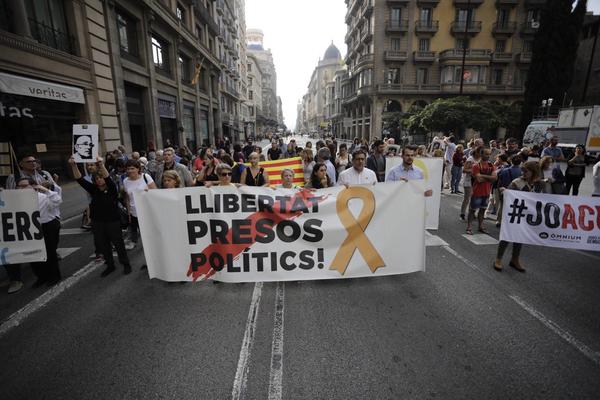
The International Trial Watch platform - Catalan Referendum Case presented its final report on the ruling of the Supreme Court against the Catalan independence leaders today in Madrid, concluding that the trial violated human rights in a "massive way." 
Specifically, according to the platform, the Catalan Trial violated the independence leaders’ right to the principle of criminal legality, right to liberty, freedom of expression, freedom of ideology, the right to peaceful assembly, political participation, as well as the right to a process with all the guarantees. 
The report was produced as a result of the presence of 62 observers in the trial from 17 different countries.
According to the conclusions of the document, the Supreme Court trial was a "violation of human rights" collected by treaties and conventions ratified by the Spanish State, that are part of its internal legal system. "It is a clearly ideological resolution aimed at replacing the political solution that is needed in the conflict in Catalonia," reads the document.
Anaïs Franquesa, a representative of the Irídia Center for the Defense of Human Rights, part of the International Trial Watch, affirmed that the sentence "clearly breaks the principle of criminal legality" that implies that the law "is not foreseeable for the condemned." 
"Criminalization" of the "right of protest"
According to Franquesa, "the foundation of the sentence" is that a crime of disobedience "becomes sedition to deter citizens from participating in mobilizations." The reality, she recalled, was that it was a "peaceful mobilization" enshrined in the "right of expression and protest" that does not justify imprisonment.
"It is criminalizing the right to protest and violent right of assembly," she said, and therefore "the fundamental right violent judgment affecting all citizens."
"Doubts about the impartiality" of the judges
The president of European Democratic Lawyers (AED), Robert Sabata, denounced that "there have been very clear violations" about the right to "a fair trial," beginning with the fact that the trial "should have taken place in Catalonia "because the facts had no effect on the rest of Spain.
The court, he said, made "an expansive interpretation" of its jurisdiction and also violated the right to "second instance." "Basically the judges were not a third party, but an interested party" and there are serious doubts about their impartiality," he said, before reminding of the media pressure and the fact that the president of the courtroom, Manuel Marchena, prevented videos that denied the testimonies of the accusations be seen in the court, which caused "material defenselessness."
In addition, according to Sabata, not only was there a "fascist party" acting as a private prosecutor, but there was a discriminatory treatment of the testimonies of the defenses and those of the accusations.
"The witnesses of the defenses were cut across by the courts and asked for their political ideologies," while when the defenses asked the same, the court didn't allow their questions.

Medio millar de juristas denuncian que la sentencia del Procés vulnera el principio de legalidad

El informe publicado por la plataforma International Trial Watch sobre la sentencia del Tribunal Supremo señala que esta viola los derechos fundamentales por falta de previsión jurídica y por menospreciar los derechos de reunión y expresión.


Manifestación en Barcelona una vez hecha pública la sentencia del reférendum del 1-O VÍCTOR SERRI
TER GARCÍA


@TERGAR_


PUBLICADO2019-11-14 15:10


“Se ha atacado uno de los principios básicos de un Estado de derecho, que es el principio de legalidad”, ha afirmado hoy Belén Caballero, presidenta de la Asociación Libre de Abogados (ALA). ALA es una de las 23 organizaciones que han firmado un informe elaborado por la plataforma International Trial Watch en el que se señalan las anomalías de la sentencia del Procés hecha pública por el Tribunal Supremo hace apenas un mes y que condena a penas de entre nueve y 13 años de cárcel a nueve de los doce acusados por las movilizaciones por la autodeterminación de Catalunya que tuvieron lugar en 2017.

International Trial Watch gestionó durante todo el transcurso del juicio del Procés la presencia de juristas de renombre de todo el mundo como observadores internacionales. A partir de las observaciones de esos juristas, publicó un primer informe en el que se señalaban las irregularidades procesales cometidas en el juicio. Ahora, un mes después de conocerse la sentencia, International Trial Watch hace público un nuevo informe en el que se analiza la sentencia y que ha sido apoyado por 23 organizaciones de juristas y por 533 juristas particulares de más de 20 países.

Otras personalidades internacionales, como la premio Nobel de la Paz Jody Williams, han querido también apoyar con su firma el informe, pero hasta el momento la plataforma solo ha recogido apoyos de juristas. Entre las organizaciones que apoyan las conclusiones del análisis figuran la Asociación Americana de Juristas, la European Association of Lawyers for Democracy and World Human Rights —compuesta por juristas de 21 países europeos—, Irídia, Red Jurídica o European Democratic Lawyers. Este informe sobre la sentencia, al igual que otros sobre lo sucedido el 1 de octubre, será remitido a la ONU, que en enero de 2020 realizará el informe periódico sobre derechos humanos en España.


“Este juicio en el Supremo no afecta solo a líderes independentistas, tiene repercusiones que afectan al ejercicio legítimo de reunión pacífica y libertad de expresión de todos los ciudadanos y ciudadanas”, subraya Caballero. “La dureza es tal que se ha atacado uno de los principios básicos de un estado de derecho, que es el principio de legalidad, haciendo cuadrar un delito tan grave como el de sedición con conductas que son ejercer derechos fundamentales como el de reunión pacífica, condenando a nueve de estas personas por sedición por llamar a la movilización”, continúa la presidenta de ALA.

“Esto tiene un efecto disuasorio para otros movimientos sociales y a las críticas legítimas al statu quo”, concluye por su parte Cristina Serván, de la Asociación Pro Derechos Humanos de Andalucía (APDHA) y de Defender a quien defiende, otras de las organizaciones participantes en International Trial Watch. “Estas conclusiones no deben ser ignoradas ni desacreditadas, hay que tomar en consideración este análisis y sus adhesiones”, reclama Serván.

FALTA DE PREVISIÓN JURÍDICAOtra de las irregularidades que la plataforma señala en la condena es la falta de previsión de que se condenara por sedición a los hechos juzgados. “Consideramos que la sentencia quiebra el principio de legalidad penal, ya que hay una quiebra cuando la ley penal no es previsible para sus destinatarios”, explica la abogada Anaïs Franquesa, abogada y miembro del Centre per la Defensa dels Drets Humans y de Irídia. Esta abogada señala que en la sentencia del Supremo, el concepto de alzamiento que contempla la jurisprudencia se ha sustituido por el desórdenes públicos y que en el fallo del tribunal ni siquiera se ha expresado un análisis de lo que es un alzamiento.


“Los observadores internacionales fueron muy mal recibidos por el resto de actores del juicio”, lamenta el presidente de la Asociación de Abogados Europeos Demócratas


En cuanto a cuándo se habría producido este alzamiento, Franquesa señala que la sentencia refiere dos momentos: “El 20 de septiembre, cuando hubo movilizaciones multitudinarias por la detención de altos cargos públicos, y el segundo momento el propio 1 de octubre, cuando multitud de ciudadanos y ciudadanas se concentraron frente a los centros de votación del referéndum, que había sido suspendido por el Tribunal Constitucional y al que se le sustrajo cualquier eficacia jurídica, como se dice en la sentencia”. Sin embargo, a pesar de que la propia sentencia señala que el referéndum no tenía efectos legales, la abogada apunta que el Supremo considera que los ciudadanos “estaban desobedeciendo”. “Si no había ningún instrumento de eficacia jurídica, difícilmente se podía estar desobedeciendo”, concluye Franquesa.

Robert Sabata, presidente de la Asociación de Abogados Europeos Demócratas (AED), ha continuado detallando las irregularidades del proceso y de la sentencia. Ha explicado cómo, aunque finalmente el equipo de observadores internacionales pudo reunirse con el fiscal del Supremo, fue imposible entrevistarse con la sala o con la Abogacía General del Estado. “Los observadores internacionales fueron muy mal recibidos por el resto de actores del juicio”, lamenta, recordando que en la lista de observadores había juristas de renombre de todos los continentes.

Como primera irregularidad, Sabata recuerda que el juicio debería haber sido celebrado en Catalunya. “Los hechos no tuvieron efectos fuera de Catalunya. Es una interpretación expansiva en cuanto a la competencia del tribunal”, explica en cuanto a que el proceso fuera juzgado por el Tribunal Supremo. La violación del derecho a la segunda instancia, precisamente también por juzgarse en el Tribunal Supremo, es la segunda anomalía señalada por este jurista. “Esa segunda instancia que se vulnera es importantísima para tener un juicio justo, según la Convención europea de derechos humanos y la Constitución española.
Jamás se habría aceptado una sentencia absolutoria o por desobediencia, los propios políticos ya daban por condenados a los acusados


En cuanto al derecho a un juez imparcial, ha subrayado que el juicio al Procés ha sido político y los jueces eran parte interesada. “Hay grandes dudas sobre su imparcialidad y, sobre todo, sobre su independencia”, afirma el abogado. “Jamás se habría aceptado una sentencia absolutoria o por desobediencia. Los propios políticos ya daban por condenados a los acusados, había un cúmulo de situaciones que hacía prever que el tribunal no era imparcial ni independiente”.

Sabata también ha recordado que, durante el transcurso del juicio, la sala rechazó que se mostraran las imágenes grabadas durante las movilizaciones cuando se interrogó a los testigos. “El hecho de no poder visionar aunque fuera de manera mínima, cuando se interrogaba a los testigos afecta al derecho de defensa, y según Marchena la pauta metodológica no lo permitía”, recuerda el presidente de AED, que también ha señalado que trato desigual que la sala mostró frente a los testigos de la defensa, a los que se preguntó por su ideología, y los testigos de la acusación, para los que la sala bloqueó cualquier pregunta en cuanto a su ideología. También señala Sabata el caos en el calendario de testificaciones. “Las defensas se vieron muy coartadas a la hora de ejercitar su derecho de defensa, hasta la semana anterior no se sabía quién iba a declarar”.


Desde la propia ONU, a través de su Grupo sobre detenciones arbitrarias, se reclamó a la justicia española hasta en dos ocasiones que se pusiera en libertad a los doce acusados por el Procés y que incluso se les indemnizara
El abogado recuerda que desde la propia ONU, a través de su Grupo sobre detenciones arbitrarias, que tiene la misma consideración que un tribunal internacional, se reclamó a la justicia española hasta en dos ocasiones —en mayo y junio— que se pusiera en libertad a los doce acusados por el Procés y que incluso se les indemnizara por el tiempo pasado en la cárcel, pero la respuesta desde el Supremo a esta reclamación fue la burla.


“El juicio se desarrolló por tempos políticos para que otras cortes internacionales no se pronunciaran. Era visible que era un juicio político y todos quedaron muy sorprendidos porque hubiera una acusación popular por parte de un partido fascista que además estaba en el parlamento”, continúa Sabata en relación a la acusación popular ejercida por Vox.

“El objeto de la sentencia es que los condenados convocaron movilizaciones para evitar el cumplimiento de las leyes. En el caso de Jordi Cuixart y Jordi Sánchez porque alentaron la movilización y mediaron con los cuerpos policiales, pero anteriormente estas movilizaciones fueron consideradas desobediencia”, recuerda Franquesa. “La sentencia da por probado que cada uno de lo llamamientos que hicieron los condenados fue a movilizaciones pacíficas y aun así da por justificadas condenas de nueve a 13 años de prisión, prescindiendo del análisis del núcleo fundamental de los derechos fundamentales en juego”, añade.

Y es que, como subrayan desde la plataforma International Trial Watch, todas las acciones por las que han sido condenados los doce altos cargos catalanes forman parte del núcleo central de los derechos fundamentales, protegidos por distintos instrumentos jurídicos nacionales e internacionales. Así lo ha expuesto también la abogada belga Mireille Jourdan, que ha recordado que para que un Estado haga restricciones a los derechos fundamentales, estas restricciones tienen que estar previstas previamente en la legislación.

“Lo que hemos visto son concentraciones de personas, y lo que se ve en la sentencia es que manifestaciones y la organización pacífica de un referéndum sin valor jurídico se convierten en un alzamiento tumultario”, explica la abogada belga. “No se entiende cómo una manifestación puede ser entendida como un delito y con condenas tan importantes. La sentencia prescinde de los derechos y de las garantías contempladas en la Convención europea de derechos humanos, hace como que no existieran”, concluye.

https://www.elsaltodiario.com/juicio-referendum-catalunya/medio-millar-de-juristas-denuncian-sentencia-proces-vulnera-principio-legalidad

Friday, 25 October 2019

UK on Catalonia crisis: Entre l’omissió i la banalització: una reflexió sobre la premsa britànica


“El lector britànic hi llegeix que el referèndum va ser il·legal, el judici just i la sentència legítima, amb una omissió flagrant dels arguments en contra d’aquesta narrativa centralista”


TIAGO MILLER13/11/2019


El Regne Unit és un dels països on, en teoria, s’hauria pogut esperar la publicació més gran d’articles sobre la sentència del Procés i les protestes posteriors. Al cap i a la fi, és un país on hi va haver dos referèndums en tan sols dos anys: el primer l’any 2014 sobre (quin escàndol!) la independència d’Escòcia, i l’altre l’any 2016 sobre la pertinència del país a la UE. A més a més, Espanya continua ocupant un lloc important dins de la imaginació popular dels seus habitants. Segons dades de la Generalitat, 2.160.300 escocesos, nord-irlandesos, gal·lesos i anglesos ens van visitar l’any passat, mentre l’Instituto Nacional de Estadística afirma que hi ha 242.837 britànics residents a tot l’Estat.

I d’articles sobre el tema n’hi havia a cabassos. El problema, però, no era una qüestió de quantitat, sinó de qualitat. Els diaris britànics es poden dividir en dos grups fixos, és a dir, els tabloids i els broadsheets, amb els últims considerats els més seriosos i fiables. No obstant això, llegir els broadsheets – cada vegada més propensos al reduccionisme i al sensacionalisme més necis – és per a mi potser com ha estat per a un independentista votar el diumenge: necessari, però millor amb el nas tapat. Malgrat el meu nas acostumat, res podia haver-me preparat pel pudor de ranci d’una bona part dels articles.


En aquests relats suposadament imparcials, el lector britànic hi llegeix que el referèndum va ser il·legal, el judici just i la sentència legítima, amb una omissió flagrant dels arguments en contra d’aquesta narrativa centralista. La seva realitat és una en la qual els manifestants són emmascarats violents, el Tsunami Democràtic el cervell de totes les protestes i els CDR separatistes radicalitzats. Qualsevol acte que no encaixa amb aquesta sinopsi predeterminada (com ara les Marxes per la Llibertat, la vaga general o les diverses manifestacions multitudinàries i pacífiques) hi ocupa un paper secundari i poc visible. Dels relats en són misteriosament absents els debats socials sobre la separació de poders, la disminució dels drets polítics i civils i la impunitat policial.


Una possible explicació d’això és que dels cinc diaris que van publicar articles sobre els fets de la setmana del 14 d’octubre només un té un corresponsal in situ a Catalunya. Tres escriuen des de Madrid, un des de Brussel·les, i l’únic que hi és resident té una íntima relació amb Ciutadans, cosa que els provoca una incapacitat (o, més aviat, una indisponibilitat) d’anar més enllà d’una mera recopilació de declaracions per part de l’Estat, els partits unionistes i la premsa espanyola més partidària. Fan una mena de copiar i enganxar periodístic en el qual van adoptant i repetint la mateixa banalització de les seves fonts, amb el resultat que acaben emprant termes com ara “violència”, “terrorisme” i “separatisme” fora de qualsevol context polític o social.

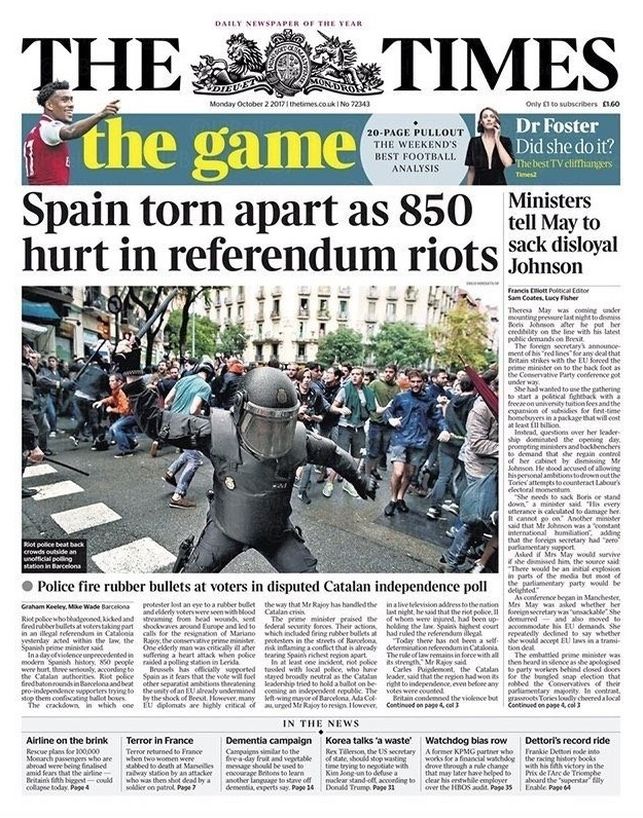
Un dels exemples més notables dels nombrosos casos de banalització política vistos darrerament va ser al Parlament quan Lorena Roldán hi va mostrar una imatge de l’atemptat a Vic amb l’intent de vincular els CDR detinguts amb el terrorisme. A fi de provocar-li al públic la reacció visceral tan desitjada, va emprar la paraula ‘Goma-2’ sense preocupar-se si hi havia proves per justificar-ne l’ús. Els dies 16, 17, 18 i 20 d’octubre, però, apareix a The Guardian, The Daily Telegraph, The Times, The Independent i The Financial Times una acusació de la mateixa gravetat quan tots afirmen que els manifestants a Barcelona “llençaven àcid” a la policia. La font d’aquesta notícia va ser un tweet (sí, un tweet) dels Mossos la nit del 16 d’octubre, en el qual deien que “continuen els incidents violents […] amb llançament de pedres i objectes amb àcid.” No se’n donava cap prova i tampoc es demanava. No sé quina de les dues coses és més greu. Però, el que sí que sé és que, igual que el mot ‘Goma-2’ al context espanyol, al britànic la paraula ‘àcid’ provoca una reacció d’horror profund.

Per donar-vos-en una idea, segons dades de la National Health Service, entre 2013 i 2018 hi va haver més de 500 hospitalitzacions per atacs amb substàncies corrosives. Es pensa, però, que la xifra verídica és encara més elevada, ja que no totes les víctimes van a l’hospital o bé per vergonya o bé per por de represàlies per part de l’agressor. A causa de les nombroses incidències, el meu és un país altament conscient dels danys físics i psicològics que poden causar aquesta mena de violència. Tots n’hem vist les fotos a la premsa i tots sabem que substàncies com l’àcid sulfúric, el lleixiu o, fins i tot, el netejador de clavegueres són capaços de deixar individus amb greus desfiguracions facials, cicatrius, problemes de mobilitat i de vista, i trastorns psicològics.

L’any passat va tornar a ser titular un dels casos més impactants i desoladors. El 23 de maig, van condemnar Berlinah Wallace a 12 anys de presó per llençar àcid a la seva exparella, Mark van Dongen, mentre aquest dormia. L’atac li va deixar en coma durant 4 setmanes. Quan va despertar-se’n, tenia cremades de tercer grau al 25% del cos, era cec a un ull i parcialment cec a l’altre. A més a més, havien hagut d’amputar-li una cama per sota del genoll, estava paralitzat del coll cap avall i tenia greus problemes de parla. 15 mesos després de l’atac, el Mark va acabar la seva vida a una clínica d’eutanàsia a Bèlgica. Tenia 29 anys. Parlant després de la sentència, el seu pare deia que “el noi patia com no pots imaginar. Tant dolor. La picor li tornava boig. Estava totalment paralitzat. Una bala hauria estat millor que això.”

A un informe de la BBC, Adele Bellis relata el seu ingrés a una unitat de cremats especialitzada després que un home contractat per la seva exparella li llencés àcid mentre esperava l’autobús. Van haver de sotmetre-la a diverses sessions de dutxes fredes per tal de rentar les ferides perquè, com explica ella, “cada cop que em van treure l’àcid, em seguia cremant i cremant.” Com explica l’informe, les cremades amb àcid poden trigar fins a 72 hores a arribar a la seva profunditat final. L’Adele es va perdre l’orella dreta, una bona part dels cabells i li van fer trasplantaments de pell a la cara, el braç i a una mà. Cinc anys després, i amb només 27 anys, encara visita rutinàriament l’hospital per rebre-hi tractaments quirúrgics.

No obstant això, les ferides físiques només en són una de les conseqüències. Molt sovint, les víctimes pateixen del trastorn per estrès posttraumàtic, la depressió i, ja que la majoria d’aquests atacs passen al carrer, una inseguretat aguda a l’hora de ser als espais públics. Dos anys després que un amic seu li llencés àcid a la cara i al cos, Joe Davies, de 23 anys, explica a una entrevista que “tindré cicatrius per tota la vida, però també en tinc les cicatrius psicològiques. Mai no podré oblidar-ne.”

En vista d’això, no seria normal que un periodista – i, a més a més, britànic – en demanés més informació? Vers una acusació tan greu, no seria normal que intentés esbrinar si n’hi havia proves abans de publicar-la? Però d’això, ni gens ni mica. Sembla que els principis fonamentals del periodisme de «Who? What? When? Where? Why?» no apliquin quan es presenta una notícia tan “sucosa”. Malauradament per a ells, l’efecte que fa és que és entre l’omissió i la banalització on aquests se sentin més a gust.

Thursday, 24 October 2019

Ben Wray – The Authoritarian Spanish Nationalism of Pedro Sánchez

In every Social Democrat there is concealed an autocratic nationalist. Social Democracy is determined by a political mentality from the 19th century. It cannot adapt, but will simply die out, as we are seeing in Europe.
Tomorrow there is a general election in Spain.

Ben Wray is is a freelance journalist based in Glasgow, Scotland and co-author of “What is Scottish Independence For?”, to be published by Verso 2019-20

Cross-posted from Bella Caledonia


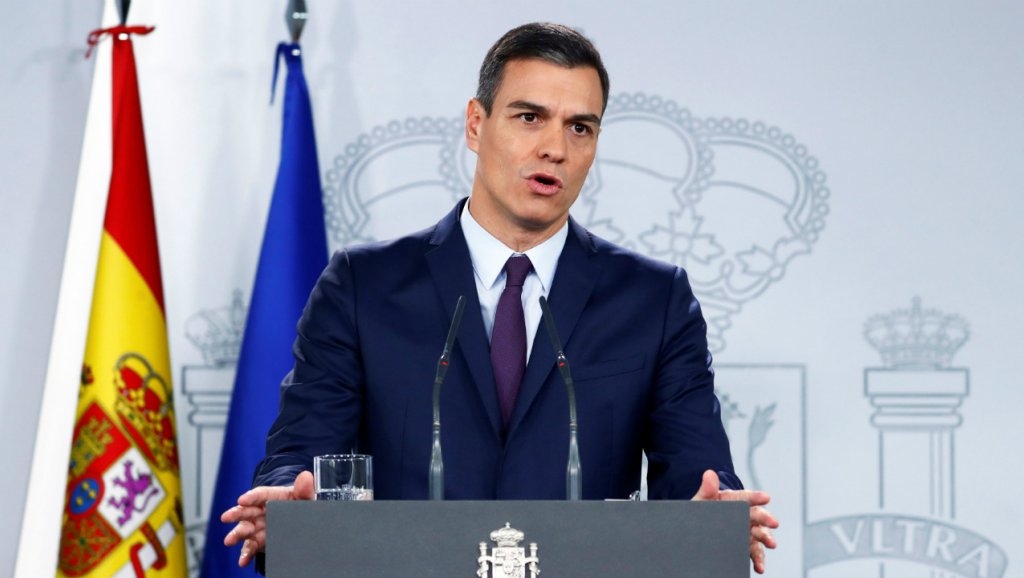
On Tuesday, Spanish Prime Minister Pedro Sánchez said the immortal words, sure to seal his fate: a vote for Sánchez was a vote for “strong and stable” government.

Sánchez has more than just rhetoric in common with Theresa May. Like the former British prime minister, he called an election in the belief that it would strengthen his grip on power in resolving a national crisis, but will almost certainly end up well short of a majority. He also shares May’s strategy, seeking to appease forces to his right by moving further and further in that direction. And with no end to the Catalan crisis in sight and an economic crisis in the post, Sánchez may well end up at the head of a government that is as “strong and stable” as Theresa’s.

Sánchez’ plan for “coexistence”

Spain’s fourth election in four years, on 10 November, has been dominated by the Catalan independence crisis, though according to Sánchez, you shouldn’t call it that. During the pre-election TV debate on Monday, the leader of PSOE said, “the crisis in Catalonia is not an independence crisis, it is a crisis of coexistence”.

Sánchez would restore confidence in “coexistence” in three ways:
“Education in civil, constitutional and ethical values”. If the Catalans want independence, they need to be re-educated out of it!
“Modify the general audiovisual Law”. Or in plain language, suppress the distribution of pro-independence information. Sánchez has not even waited until the election before acting on this one. On Tuesday his government passed by Royal Decree a new law giving it the power to seize any telecoms infrastructure deemed “a grave public disturbance” without judicial review. The ‘Decree Law’, in many ways similar to the post 9/11 Patriot Act of George W. Bush, is limited only by the government’s “clear interest in proportionality”, which can clearly be defined whichever way the government wishes.
“A new crime to prohibit the holding of illegal referendums”. In other words, ratcheting up the judicial repression of democracy.

If these sounds like the policies of a hard-right authoritarian regime, that’s because they are.

But there’s more. During the debate Sánchez also vowed to extradite former Catalan President Carles Puigdemont. Asked afterwards how he could do this given the judiciary is supposed to be independent, he said: “Who does the prosecutor answer to?’ The interviewer replied: “To the government.” Sánchez: “Then, that’s it.” Spain’s Prosecutor Association had to issue a statement on Wednesday reminding Sánchez of the need to keep-up appearances.

Remember, Sánchez represents the left of Spanish nationalism. But when your starting point is to accept “the indissoluble unity of the Spanish Nation”, as it states in the constitution, then under the pressure of a democratic challenge to that position, your nationalism is always likely to slide rightwards pretty fast.

The nationalism of the state: from banal to authoritarian

Of course Sánchez would reject the term Spanish nationalist. To Sánchez, the nationalists wave Catalan flags; his politics are its antithesis. But when your commitment to the Spanish nation-state and its constitution above all other concerns is so transparent, what else could we possibly call it?

Social psychologist Michael Bilig coined a term that’s useful in helping us conceptualise the every-day nationalism which reproduces allegiance to the state: “banal nationalism”.

The dominant use of nationalism was “misleading”, Bilig found, because it “always seems to locate nationalism on the periphery” and “overlooks the nationalism of the West’s nation-states”.

Banal nationalism is so hegemonic in normal times that it is largely unnoticed, while being constantly reinforced.

“Daily, the nation is indicated, or ‘flagged’, in the lives of its citizenry,” Bilig argues. “Nationalism, far from being an intermittent mood in established nations, is the endemic condition…The metonymic image of banal nationalism is not a flag which is being consciously waved with fervent passion; it is the flag hanging unnoticed on the public building.”

Sánchez desires to be a banal nationalist; his viscerally ideological commitment to the nation-state unseen, unquestioned. But under the strain of the Catalans’ challenge to the authority of the Spanish state, Sánchez’ Spanish nationalism reveals itself as not so banal after all, and more belligerently nationalistic than the Catalan nationalism he condemns.

Spain’s weak ‘transition’

Authoritarian Spanish nationalism did not fall out of a clear blue sky. Indeed, from the perspective of the Basques, who have been on the receiving end of judicial repression and police brutality for decades, the treatment meted out to the Catalans is more continuation than rupture with the post-Franco Spanish state.

The character of Spain’s ‘transition’ following fascist dictator Francisco Franco’s death in 1975 was one that kept much of the institutional integrity of his rule in place. That legacy has left various problems unresolved, including systemic political corruption, economic oligarchy and a sclerotic civil service. But most pertinently to the current crisis is the legacy of a highly politicised judiciary, a vicious and large police force and a repressive political culture, dominated by a small establishment class of two parties, PSOE and PP.

David Whyte and Ignasi Bernat believe it to be the “the legal apparatuses of the state” left-over from the Franco era which is the unique characteristic of Spanish nationalism.

“What marks out Spanish nationalism is the extent to which principles of Spanish unity are enforced, without mercy, by the legal apparatuses of the state. There is a deep residual nationalism at the heart of the Spanish state which has its roots in the Franco period, and has never been adequately purged after the dictatorship,” they write.

It’s not hard to find evidence of this, and usually operates under the not-so subtle guise of “terrorism” offences. TsunamiDemocratić, which has led recent Catalan independence protests, has been hit by trumped up “terrorism” charges from the Spanish National Court in recent weeks.

This tactic of the Spanish state has been honed over many years in the Basque Country’s ETA era. Despite ETA officially dissolving last year, the Spanish state won’t let it go, so useful was it as a cover for generalised repressive measures.

This reached the theatre of the absurd in the case of the Altsasu incident, where eight young Basque people involved in a bar fight with two off-duty Guardia Civil officers was described as a “terrorist attack” by the public prosecutor, who called for sentences of between 12 and 62 years. The National Court dismissed the terrorism charge, but they still received sentences of between two to 13 years.

‘Nation’-states under strain

While Spain has its own unique dimensions, its increasingly authoritarian nationalism is also part of a trend of contemporary global politics where democracy and civil rights is under pressure everywhere. The state’s that are perhaps showing most sign of creaking are those with a pluri-national character. Spain, Turkey and the UK have much in common in this respect.

It was not by coincidence that Sánchez was the first leader of an EU state to back Turkey’s war on the Kurds, while the Turkish government has justified its removal of three Kurdish mayors by citing the example of Spain’s jailing of pro-independence Catalan leaders. Recep Tayyip Erdoğan’s ethnic cleansing of Kurdish Syria is partly about squashing a challenge to the country’s systematic discrimination against the Kurdish minority within Turkey’s borders, which has been a consistent policy of Turkish governments since the state was formed nearly 100 years ago.

Meanwhile, the UK state in the Brexit era is increasingly overwhelmed by multiple threats at the Scottish, Irish and Welsh national levels. In the Scottish case, the response has been an increasingly intransigent one by first Theresa May and then Boris Johnson’s government’s towards the right of Scotland to self-determination. The British nationalism of 2019 is moving closer to that of Spain than David Cameron’s government of 2012, when the Edinburgh Agreement was signed with the Scottish Government for a legally binding independence referendum without too much fuss.

There is no reason to believe in the case of Spain, Turkey or the UK, or in fact anywhere else for that matter, that political conflict along national lines is going to dissipate in the future. Stateless nations act as a common identity for oppositional politics to organise around, while nation-states seek to defend their territory and sovereignty in a highly competitive, claustrophobic international economy. The ‘national question’, as Wolfgang Streeck recently observed, has been ‘badly underestimated’ as a crucible of 21st century politics, especially by the left.

Conclusion

What Sanchez proves is that authoritarian nationalism in defence of the state is not only the preserve of the official right-wing. Where it will end up we don’t know, but history suggests that Sanchez may well be the handmaiden of forces he can’t control. A political climate where repression is normalised and legitimate is inevitably a breeding ground for fascism.

The far-right Vox is, according to some polls, set to come third in Spain’s election on Sunday. Its leader, Santiago Abascal, was part of the national TV debates on Tuesday for the first time, and his calls for ratcheting up the repression were – disturbingly – not out of place with the general discourse of the debate, and barely challenged by the other leaders.

The Spanish left, like the Turkish left and the British left, needs to get to grips with the reality of where the real threats and dangers are coming from. If they genuinely are opposed to nationalism, the primary nationalism they must be concerned with is that of their own state.
If you like this kind of article and want to see more writing free of state or corporate media bias and free of charge, please donate here. We welcome your support.
We are in the midst of our Fundraising 2019, so please give generously.

Wednesday, 23 October 2019

John Bercow (former Speaker of UK Parliament) describes Spain's sentencing of Carme Forcadell

Tuesday, 22 October 2019

Jon Inarritu!! Oratoria sobria y justa: Parrehsia


Escandalosa manipulación de la Polícia del Estado de los presos miembros de CeDeR