Monday, 5 August 2019

How the far right in Spain has seized on bullfighting to make its point Guillem Martínez


How the far right in Spain has seized on 
A ‘sport’ that went out of fashion after Franco is the axis of a new cultural battle as nationalism seeks to re-establish itself
Protest against bullfighting in Palma
 ‘To drown out the demonstrators, Cara al Sol – anthem of the Spanish fascist party, the Falange – was played over the loudspeakers.’ Photograph: LLITERES/EPA
Last Friday, after a brief prohibition, bullfighting returned to Mallorca. The bullfight was well attended and it was met with a demonstration by a large group of animal rights protesters. To drown out the demonstrators, Cara al Sol (Facing the Sun) – the anthem of the Spanish fascist party, the Falange – was played over the loudspeakers. What exactly is going on here?
The cult of the bull on the Iberian peninsula goes back millennia, but bullfights are a more recent phenomenon. They date to the 18th century when Felipe V, the first of the Bourbon kings, banned and disparaged bullfighting by the aristocracy. Old-style bullfighting – nobles on horseback fighting bulls with lances – died out, giving rise to a new type of bullfighting, on foot and practised by the common people.
This bullfighting had already taken form by the beginning of the 19th century when the Napoleonic invasion gave rise to Spanish nationalism. During the 1830s bulls became a metaphor for nationalism during the civil war between the absolutist Carlists and the liberals. Bullfights, now newly signifying liberalism, expanded throughout Spain.
This was the case in Barcelona: in the 20th century there were three bullrings in the city – an indication of bullfighting’s popularity, even among Catalanist republicans. This popularity came to an end with the Franco regime under which bullfights came to be a metaphor for a supposed race, a homogenous nation and an identity that was misunderstood in Europe.
The political colonisation of a popular pursuit led to the gradual distancing of the public from bullfighting – as people also distanced themselves from Francoism and Spanish nationalism. The Catalan parliament passed laws to protect animal rights and in 2011 banned any spectacle involving cruelty. That spelled the end of bullfighting in Catalonia – there are now no bullrings in Barcelona.
For nationalist reasons rather than to protect animals, the same law that banned bullfighting, seen as a definitively Spanish pursuit, permitted Catalan bull festivals such as the “bulls of fire”, a “sport” involving bulls with flaming material fixed to their horns – although the practice is cruel too.
In 2013 the constitutional court declared the Catalan ban an unconstitutional prohibition of “Spanish cultural heritage”. The same thing happened in Mallorca, only faster. In 2017, Catalan-speaking Mallorca banned spectacles that involve brutalising animals. In 2018 the ban was declared unconstitutional and last week the tradition resumed and was united with another: playing of the Cara al Sol.
The manner in which the bullfighting tradition was repositioned in Mallorca, along with its soundtrack, represents a sudden change. Bullfighting has become the axis of a new cultural battle between peninsular nationalisms. When the coalition government was established in Andalucía earlier this year, bringing together the conventional rightwing Popular and Citizens parties with Vox, a party in the same orbit as France’s Rassemblement National, there were four core issues: bullfighting, hunting, ending measures against gender violence and those regarding historical memory – in effect, against any moral reparations for the losers in the civil war.
The new Madrid regional government, comprised of the same three parties, has also alluded to these issues, as well as bringing in pro-bullfighting measures, which is odd, because bullfighting isn’t under any threat in Madrid or Andalucía. This is an indication that what is occurring here is an underlying cultural battle and, by extension, the reformulation of Spanish nationalism.
The idea is that there are Spanish people who love tradition, bullfighting and hunting, who have had to give a lot of ground since the death of Franco in 1975, and who wish to revive their supposedly threatened traditions. A speech delivered in October 2017 by King Felipe VI – descendent of Felipe V who, unknowingly, created the 18th-century bullfight – in which he alluded to the Catalan crisis by stating that Spain is a finished state in no need of reform, is closely related to this idea of returning to a better past.
The Popular and Citizens parties, as well as Vox, talk about this a lot in their electoral meetings and about what they claim are attacks on individual liberty and on national values such as bullfighting, hunting, the Spanish language and the family. These values can also include a vindication of victory in the civil war – and Cara al Sol. To encompass all of this, sometimes all it takes is a bull.
Translated from Spanish by Stephen Burgen
•Guillem Martínez is a journalist and writer. He has published books on Spanish culture and politics, as well as on the Catalan sovereignty process

Retrofuture News & Articles: 2010 España NO Existe

https://kv53139.blogspot.com/2010/08/espana-no-existe.html

"If you're Spanish, speak Spanish": how Castilian became Spain's dominant language


Read in Catalan

Main image: Franco-era propaganda, "If you're Spanish, speak Spanish" / Source: Enciclopèdia Catalana

Zalamea de la Serena, 18th August, 1492. On that day, five hundred and twenty-seven years ago, in a town in Extremadura, then part of the Kingdom of Castile, Antonio de Nebrija completed his Grammar of the Castilian Language, in which he proclaimed: "Language has always been a partner of empire”. Thirteen years earlier, the Catholic monarchs, Ferdinand and Isabella, had consummated the dynastic union of the crowns of Castile and Aragon, the two largest territories on the Iberian peninsula. Nebrija, close to Isabella of Castile, wasn't inventing anything himself with his assertion on language and empire; rather, in the context of a difficult balancing act between two power centres, he was simply spelling out an ideological tenet of the Castilian model for Spain: that language was to be used as a tool at the service of a political project. Thanks to the efforts of Isabella's chancery, "Castilian" was - in time - rebaptised as "Spanish"; and, along with the Catholic religion, it was presented as an essential ingredient for bringing about social, political and cultural unification.


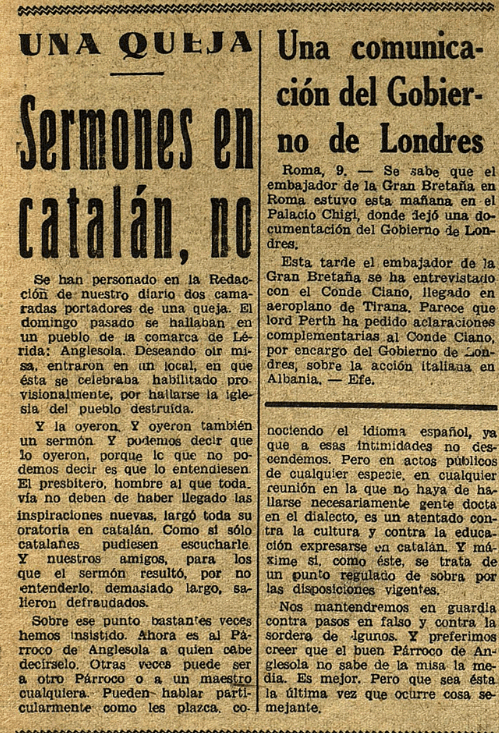
Cutting from the Francoist newspaper Solidaridad Nacional, 13th April, 1939. The left-hand title reads "A complaint: Sermons in Catalan, no" / Source: Barcelona City Council


Why Castilian and not another Iberian language?

In 1492, the Castilian tongue was not even close to being the majority language in the territories ruled by the Hispanic monarchies. At a popular level, the language was totally unknown in Catalonia, Valencia, the Balearic Islands, Galicia, Asturias and in the eastern half of Andalusia. It was only partially familiar to people in León, Aragón, Navarra and Euskadi. And even within its own linguistic domain it was fragmented into dialects so differentiated that a livestock herder from La Mancha could find it very difficult to understand an Andalusian merchant, if he had to. This was one of the motives for Nebrija's great work on the grammar of the Castilian language: to put the language in order and to unify criteria. But, on the other hand, the Castilian already spoken at the court was a key common element, either maternal or acquired, among many members of a powerful medieval lobby of personal and family interests: the Iberian dynasty of the Trastámara which, decades earlier, had managed to seat its backsides on the two main peninsular thrones.

The balance tilts


Any explanation of the rise of Castilian to the category of a language of power and culture has to focus on the bitter struggle between the two branches of this Trastámara power group: the Castilian landowning latifundista oligarchies of Isabella, versus the Catalan-Valencian mercantile classes under Fernando. This early modern "cold war" did not have language as an element in dispute, but it did include a drive to raise the category of Castilian; and simultaneous with this was the creation of a new narrative, totally falsified, concealing the Catalan-Valencian participation in the colonization of America, thus revealing how the balance had then tilted towards the side defended by Torquemada(inquisitor general), Nebrija (language and empire) and Fernández de Bobadilla (the judge who imprisoned Christopher Columbus). Curiously, these three paradigmatic characters had certain aspects in common: their language, their allegiance to the circle of friendships of Isabella, and their public repudiation of their cultural and family origins, which had been Jewish.

The Bourbons didn't invent anything


Philip V, the first Hispanic monarch from the Bourbon dynasty, was also, the first king of Spain. This is not just a minor detail: Philip V attempted to culminate, through bloodshed and warfare in the early eighteenth century, the project conceived two hundred years earlier by Torquemada, Nebrija and Fernández de Bobadilla. In this case "by right of conquest”. Between Philip V (1707) and Ferdinand VII (1808), Castilian was imposed by force - and as the only acceptable language - in schools, justice, the theatre, religious offices, commercial affairs, government administration and in publications. Spanish national unity, the byword of the Bourbon regime, embodied in the figure of an absolutist king, was based on the architecture of a Spain sketched out by Castilian power: the landowning oligarchies who were the ideological heirs of Isabella, the Catholic queen. This, in clear opposition to the traditional Catalan idea of Spain, represented by Rafael Casanova, in 1714, when in defence of the besieged Barcelona he cried out: “per la llibertat dels pobles d’Espanya” - calling for the freedom of the peoples of Spain - in plural and in Catalan.


Isabella the Catholic, Torquemada and Nebrija / Source: Wikimedia Commons


"Long live La Pepa!"


However, a century of prohibitions and persecution under the Bourbons did not put an end to the Catalan language. "Castilianization" - that is, the imposition of Castilian across Spain - had not even taken root among the country's ruling elites. What did occur, though, was an aesthetic transformation of the Castilian ideology of Spain: Spanish liberalism (the purist, pedigree interpretation of French revolutionary Jacobinism) imagined the Spanish homeland (in its Castilian version) as the one and only true mother of all its Iberian children. In Cádiz, in 1812, the anti-Napoleonic oligarchies that proclaimed the first Spanish Constitution - La Pepa as it was popularly known - accused their Catalan, Valencian and Mallorcan companions of being backward and illiterate due to their lack of knowledge of Castilian. In contrast, in Barcelona, also in 1812, the ruling French military prefect Argereau (Catalonia had been incorporated into the French Empire) had restored the official status of the Catalan language.

"Up with Spain!"


It may be hard for some to stomach, but the truth is that the La Pepa constitution is the mother of Spanish nationalism. During the 19th century, Spanish liberal governments decreed just as many laws imposing the Castilian language as the absolutist Bourbon regime had during the previous century. Castilian, with a renewed idea of Spanish-ness, was reinforced as the language of power and culture; and, in that landscape of supposed liberalism, it was consecrated as the only possible language of the country. It was a qualitative leap in which the military also played a key role: the expression ¡Arriba España! - "Up with Spain!" from the Franco dictatorship (1939-1975) is nothing more than the historical evolution of the precedent ¡Arriba el rey! - "Up with the king!" used by the Bourbon soldiers fighting the Catalan resistance in 1714, or the royalist Spanish soldiers fighting against the Latin American armies of independence during the first decades of the nineteenth century. For obvious reasons, Catalan, Basque and Galician were never languages of the Spanish army.

“... and long live Franco”

And, no matter how difficult it is for some to accept, La Pepa is also the grandparent of Spanish fascism, insofar as it was Spanish nationalism which begat Spanish fascism. In 1939, with Franco's occupation of Catalonia completed, the first law that was decreed by the new regime was the one prohibiting the use of Catalan in public. Curiously, that same historical moment also saw the replication - with the chronological differences that were logical - of certain schemes carried down from the Nebrija era, leading to many remarkable anecdotes. There was a climate of tension between Catalan Francoists and the hard core of the dictator's regime and although it did not have its maximum expression in the area of language, the tightening of linguistic persecution directly correlated with the escalation of tension. It was significant that many of the Catalans who had joined the Francoist rebellion - and who had become the civilian arm of the dictator's regime in Catalonia - came from the most conservative sector of the extinct Regionalist League, led by Francesc Cambó.

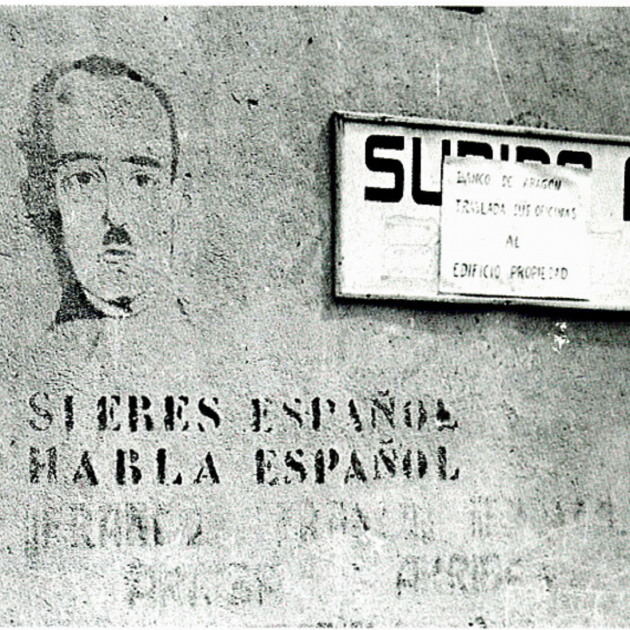
"If you are Spanish, speak Spanish”
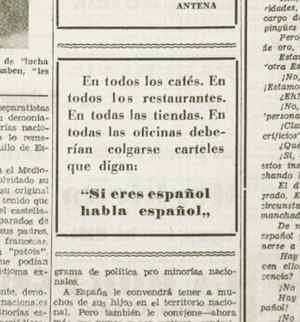
Ramon Serrano-Suñer, number two figure in the Franco regime and popularly known as the cuñadísimo - the "special brother-in-law" - tried to stop the linguistic clampdown, and at a meeting of Franco's cabinet (1939) he proposed maintaining the official status of Catalan, with the stated aim of winning over the Catalans to the Francoist cause, and the unstated aim of benefitting Cambó's people. The cuñadísimo was born in Cartagena, but he had spent all the summers of his youth in Gandesa, at the house of his Catalan-speaking maternal family, and knew the Catalan sociological landscape very well. Especially its conservative Carlist (monarchist) variant. Franco and his hardcore resolved the matter with an ideological coup: “We want national unity to be absolute; with a single language, Spanish; and a single character, the Spanish character”. At the same time the country's large cities were invaded by a propaganda campaign that proclaimed "If you are Spanish, speak Spanish "(using graffiti, posters both on the street and in private premises, and press advertisements).


Press advertisement: 'In all cafes. In all restaurants. In all shops. In all offices you should put up signs that say: "If you are Spanish, speak Spanish."' / Source: Blog Premsa Història
"Catalan dogs, you don't deserve the sun that shines on you"

That mostly-muffled conflict also left other anecdotes: in the first mass held in Tarragona cathedral after the Francoist forces occupied the city (January 1939), the Castilian canon José Artero offered the following threat from the pulpit: “Catalan dogs, you don't even deserve the sun that shines on you." And in Reus, the mayor Josep Amézaga Botet, appointed personally by Franco, was summarily dismissed (June 1939) by the civil governor of Tarragona, colonel Machado Méndez, accused of allowing the use of Republican administrative forms, printed in Catalan! These are only two among thousands of anecdotes. However, something must have remained of Serrano-Suñer's initiative, or of the ability of conservative Catalanism to move tactically. The Franco regime would later confirm the category of "national language" which Castilian had been awarded under the liberal governments of the nineteenth century. Yet it would tolerate the use of Catalan behind closed doors: in those places where the sun doesn't shine.

“... let this be the last time it happens”


And this modus operandi has survived to the present day. Appropriately dressed up in liberalism, modernity and universality. You can at least see it living on, in recent statements to the president of the Barcelona Chamber of Commerce, from a politician who, in France, deported Roma people and who in the Catalan capital decides majorities. A cutting (reproduced near the top of this article) from Solidaridad Nacional, the press organ of the Franco regime in Barcelona (edition of 13/04/1939), entitled "A complaint" - it reads like a bad joke - is full of insight. It explains that two "colleagues" went to mass in the rural Catalan locality of Anglesola and left without having understood anything said, because the rector gave his sermon in Catalan. The writer's feathers were, to say the least, ruffled: "Privately, you may speak as you please (...) but in public acts (...) where there are people unfamiliar with the dialect, it is an act against culture and against education to express oneself in Catalan (...). And the article ends up threatening: “...let this be the last time anything similar happens”.

Sunday, 4 August 2019

El ex-ministro Margallo amenaza a los catalanes: “España no se retirará nunca pacíficamente de Catalunya”


ULTRANACIONALISMO ESPAÑOL


El ex-ministro de Asuntos Exteriores José Manuel García – Margallo ha amenazado hoy y ha afirmado que España no se retirará ‘pacíficamente’ de Catalunya

‘No se entregarán las llaves de las dependencias ni se arriará la bandera’, afirmó en La mañana de Cataluña Radio. El ex ministro dijo que está a favor de las acusaciones por rebelión contra el gobierno de Puigdemont, la presidenta Forcadell, Jordi Cuixart, Jordi Sánchez y la secretaria general de ERC, Marta Rovira.

Según él, la vía unilateral para lograr la independencia conlleva ‘necesariamente’ violencia.

Así ha sido el polémico corte de la entrevista:


Mònica Terribas –
Hay delito de rebelión o no?

García-Margallo– Yo creo que sí hay delito de rebelión. Comparto las tesis de Llarena, es decir, creo que lo que vimos en las calles durante el registro de la consejería de Economía era violento. Creo que por definición, la secesión unilateral sólo se puede conseguir por la violencia.

Es decir, digo que hipotéticamente que esto lleva a la violencia. ¿Por qué? Lo hemos discutido muchas veces y estamos todos de acuerdo, la constitución no permite la secesión, punto uno. Por lo tanto no habrá un referéndum acordado.

Segundo, España no se retirará pacíficamente, es decir, no entregará las llaves de las dependencias y arriará la bandera. Entonces, como se proclama la República Catalana? Si no puede ser mediante acuerdo y no puede ser por abandono unilateral, pues deberá ser por la violencia. Y eso, necesariamente, lleva a la rebelión.


más info: https://diario6.com/el-ex-ministro-margallo-amenaza-a-los-catalanes-espana-no-se-retirara-nunca-pacificamente-de-catalunya/#.XVML8BTyrgk.twitter

Testimonios y cuestiones sobre la manipulación Orwelliana de la realidad por el estado Español, sus jueces, abogados de fiscalía del estado

un ejemplo hirente de la disociacion mental y perversion del lenguaje significante

Saturday, 3 August 2019

La Aristocracia del Imperio contra Catalanes en Blanquerna sigue impune+Uno de los ultras de Blanquerna en libertad es cuñado de De Vigo y primo de Morenés


Iñigo Pérez de Herrasti es uno de los acusados por el ataque al Centro Cultural Blanquerna el año 2013 y que no tendrá que entrar en prisión por decisión del TC, como se ha conocido este miércoles. Por el nombre, posiblemente, no llame la atención, pero Pérez de Herrasti tiene un importante historial declictivo y vínculos familiares con el actual ministro de Educación y portavoz del gobierno español, Íñigo Méndez de Vigo, y con el exministro de Defensa Pedro Morenés Eulate.
El asaltante, de unos 60 años y dirigente de Alianza Nacional, es primo de Morenés por parte de madre. A la vez, también es cuñado de Méndez de Vigo, ya que su hermana, María Pérez de Herrasti, está casada con el ministro.
Entre el historial penal de Pérez de Herrasti, consta una condena de 14 años de prisión el año 2000, al ser detenido -junto con tres miembros de grupos neonazis- con explosivos y armas para atentar contra familiares de presos de ETA que viajaban a la capital española para visitar los encarcelados.
Siete años más tarde, Pérez de Herrasti hizo una huelga de hambre, acompañado de Pedro Pablo Peña, miembro de Alianza Nacional, para protestar contra lo que veían como un trato de favor hacia los presos de ETA.
Además, el ultra es hijo de marqueses. Su padre, Ramón Pérez de Herrasti y Narváez, es el decimocuarto marqués de Albayda, y su madre, Begoña Urquijo y Álvarez de Eulate, es hija de los marqueses de Bolarque y forma parte de la familia de los marqueses de Urquijo.
La Sala Segunda del Tribunal Constitucional ha acordado este jueves suspender la ejecución de la pena de prisión que le impuso el Tribunal Supremo, junto con la de cuatro ultras más, que asaltaron violentamente el Centro Cultural Blanquerna el 11 de septiembre del 2013, mientras tenía lugar el acto institucional de la Diada de Catalunya en Madrid.